Non-adhesive binding: books without paste or glue / Keith A. Smith
Type
Book
Authors
ISBN 10
092715904X
Category
Publication Year
1990
Publisher
The Sigma Foundation, United States
Pages
318
Subject
Bookbinding
Abstract
"Non-Adhesive Binding: Books without Paste or Glue, demonstrates basic and elaborate bindings constructed without adhesives and requiring no presses or other heavy equipment. A needle, a pair of scissors, and a few other minor tools are all that is needed.
Books without Paste or Glue speaks of an approach to binding. In creating a book, as opposed to binding an existing one, binding should not be an afterthought but an integral part of the book statement. Physical structure facilitates action of turning pages. Design continues, if not determines content. Craft is useless without function, and accessibility is sterile without content. "
Books without Paste or Glue speaks of an approach to binding. In creating a book, as opposed to binding an existing one, binding should not be an afterthought but an integral part of the book statement. Physical structure facilitates action of turning pages. Design continues, if not determines content. Craft is useless without function, and accessibility is sterile without content. "
Description
Not Currently Available For Borrowing
Contents
Part 1 – Preparation for Binding:
One One-Fold Book
Two Two-Fold Books
Triads
The Dove Tail
Coming to Terms
Supplies
Part 2 – Descriptions For Bindings
3-Hole Pamphlet Stitch
4-Hole Pamphlet Stitch
5-Hole Pamphlet Stitch
5-Hole Variation
Two-Section
Part 3 – Covers
Part 4 – Reference
(Book in box)
Contents
Part 1 – Preparation for Binding:
One One-Fold Book
Two Two-Fold Books
Triads
The Dove Tail
Coming to Terms
Supplies
Part 2 – Descriptions For Bindings
3-Hole Pamphlet Stitch
4-Hole Pamphlet Stitch
5-Hole Pamphlet Stitch
5-Hole Variation
Two-Section
Part 3 – Covers
Part 4 – Reference
(Book in box)
Biblio Notes
Book is signed by Keith Smith 3rd May 2000 "Brisbane Workshop" with dedication "Good luck June"
Donated by June McNicol.
Binding by June McNicol
Binding Notes:
Class 129 The Chips Strange Memorial.
Non-Adhesive Binding
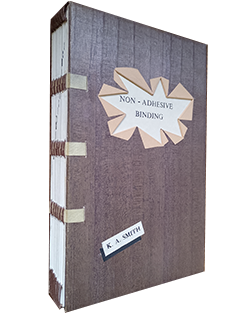
This is a conservation/fine binding suggested by one of the bindings in the book. It is bound so that it can be disbound with minimum damage to the sections by merely cutting the sewing threads. All the binding processes are clearly visible. Adhesive was used only on the boards which can be easily removed from the book.
The sections were trimmed before sewing to emphasize their individuality and then sewn decoratively with linen thread over three vellum tapes. Headbands were constructed, using the same linen thread and tying down into each section for strength.
Endpapers of acid free paper strengthened with jaconette were sewn on. No effort was made to reduce the wedge of the shape of the text.
The design contrasts with the importance of the solid black compared with an apparent illusion of fragility of the boards, which show many contradictions: they appear to be made of wood, but are not, one of them appears to be broken, but is not, whilst the author's name seems to be floating at random.
Boards of double Archivite were lined on both sides and laminated for stability, the vellum tapes being laced through the top board only. The boards were beveled and covered with Japanese wood paper to simulate wooden boards, signifying great strength.
A 'broken' section on the top board reveals the title and the 'floating' author's name was inlaid.
A box was made of thick board, lined with Ingres, covered with crash canvas and held closed with a heavy webbing belt, to give feeling of strength and permanence.
Donated by June McNicol.
Binding by June McNicol
Binding Notes:
Class 129 The Chips Strange Memorial.
Non-Adhesive Binding
This is a conservation/fine binding suggested by one of the bindings in the book. It is bound so that it can be disbound with minimum damage to the sections by merely cutting the sewing threads. All the binding processes are clearly visible. Adhesive was used only on the boards which can be easily removed from the book.
The sections were trimmed before sewing to emphasize their individuality and then sewn decoratively with linen thread over three vellum tapes. Headbands were constructed, using the same linen thread and tying down into each section for strength.
Endpapers of acid free paper strengthened with jaconette were sewn on. No effort was made to reduce the wedge of the shape of the text.
The design contrasts with the importance of the solid black compared with an apparent illusion of fragility of the boards, which show many contradictions: they appear to be made of wood, but are not, one of them appears to be broken, but is not, whilst the author's name seems to be floating at random.
Boards of double Archivite were lined on both sides and laminated for stability, the vellum tapes being laced through the top board only. The boards were beveled and covered with Japanese wood paper to simulate wooden boards, signifying great strength.
A 'broken' section on the top board reveals the title and the 'floating' author's name was inlaid.
A box was made of thick board, lined with Ingres, covered with crash canvas and held closed with a heavy webbing belt, to give feeling of strength and permanence.
Number of Copies
1